
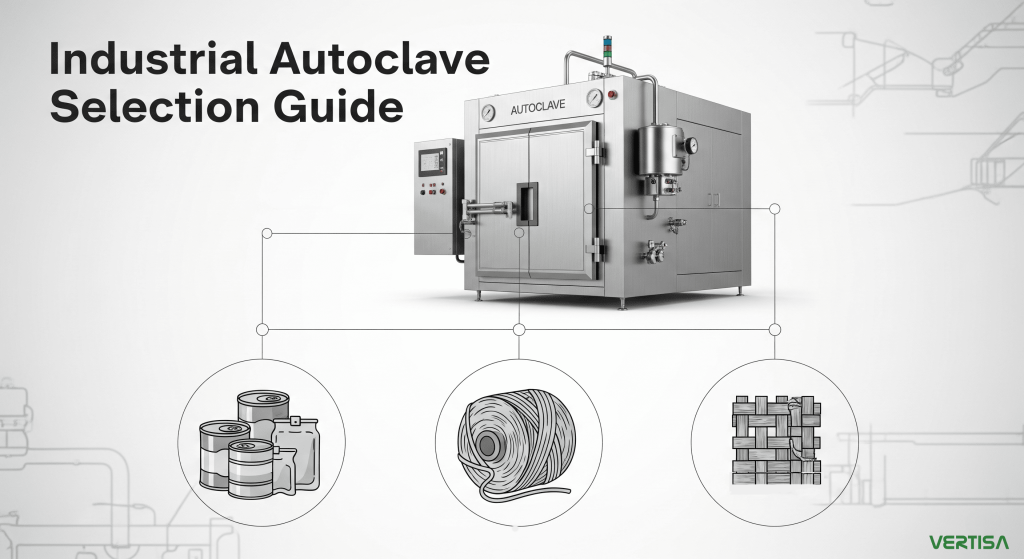
Although hospitals and sterilization are the first things that come to mind when we think of autoclaves, the use of these powerful devices is not limited to the medical field. Autoclaves, which perform sterilization, curing, and various industrial processes using pressure and temperature, play a critical role across a wide spectrum—from extending the shelf life of foods to producing aerospace components. However, each industry has different needs, and choosing the wrong autoclave can reduce production efficiency, impair product quality, and even create safety risks. Therefore, it is vital to proceed with a comprehensive autoclave selection guide before making an investment.
In this article, we will highlight the importance of autoclaves in the industrial world and examine, step by step, the technical criteria to consider when selecting the right autoclave for key sectors such as food, textiles, and composites. To learn more about Vertisa’s advanced industrial autoclave solutions and explore options tailored to your project, you can visit our product page.
Fundamental Criteria for Autoclave Selection: Golden Rules for Every Industry
Before delving into sector-specific details, there are universal factors that must be considered in every industrial autoclave purchase. These fundamental criteria ensure that you are on the right track.
- Capacity and Size: What volume do you need? Selecting an autoclave in dimensions suited to your production line’s output is critical for energy efficiency and operational flow. An autoclave that is too large leads to unnecessary energy consumption, while one that is too small causes bottlenecks in production.
- Material Quality and Durability: Autoclaves operate under high pressure and temperature. Therefore, the vessel (pressure vessel) material should generally be made of corrosion-resistant, high-strength materials such as 304L or 316L stainless steel. Compliance with international pressure vessel standards such as ASME and PED is a guarantee of safety and long service life.
- Pressure and Temperature Range: What maximum temperature and pressure values does your application require? For example, curing a composite material may require much higher temperature and pressure than sterilizing a canned product. Ensure that the device’s operational range meets your process requirements with a safe margin.
- Control Systems and Automation: Modern autoclaves are equipped with PLC (Programmable Logic Controller) systems that provide precise control. Features such as precisely programming process cycles (heating, holding, cooling), keeping data records, and remote monitoring are indispensable for standardization in product quality and backward traceability.
Autoclave Selection Guide for the Food Industry
In the food industry, autoclaves are commonly referred to as “retorts,” and their primary purpose is to render low-acid foods such as canned products, ready-to-eat meals, and baby foods commercially sterile by eliminating dangerous microorganisms like Clostridium botulinum. In this way, the shelf life of products can be extended for months even at room temperature.
Sterilization Method: Different heat-transfer methods are used in food autoclaves. The most common are:
- Saturated Steam: An efficient method ideal for robust packaging such as metal cans.
- Water Spray: Used to prevent deformation of pressure-sensitive packaging such as flexible pouches and plastic containers. Counter-pressure (overpressure) inside the autoclave is controlled precisely.
- Steam-Air Mixture: Preferred especially for packages that contain headspace.
Compliance with Standards: The autoclave to be selected must comply with the regulations of FDA (U.S. Food and Drug Administration) and similar local food safety authorities (for example, 21 CFR Part 111).
Uniform Heat Distribution: It is critically important that each product inside the autoclave is exposed to thermal processing equally. Therefore, heat distribution tests and validation reports must be reviewed when making a selection.
Manufacturers like Vertisa develop retort solutions tailored to the food industry’s sensitive needs, offering precise pressure and temperature control optimized for different packaging types.
Selecting the Right Autoclave for the Textile Industry
In the textile industry, autoclaves are used for purposes such as dye fixation, improving the moisture and strength properties of yarns (conditioning), and steam-processing technical textiles.
- Vacuum Capability: For dense materials like yarn packages or fabric rolls, a strong vacuum system is essential to allow steam to penetrate to the innermost layers. Pre-vacuum performed before the process removes the air inside, enabling homogeneous steam distribution.
- Precise Temperature Control: In processes such as dye fixation, precise temperature control is critical for color consistency and vibrancy. Sudden temperature fluctuations can cause color differences between product batches.
- Steam Quality: The steam used in textile processes must be dry and clean to avoid leaving stains or residues on the fabric. Therefore, the autoclave’s steam supply system must be suitable for this need.
Critical Autoclave Selection Guide for Composite Material Production
The production of composite materials such as carbon fiber- and glass fiber-reinforced polymers (CFRP/GFRP), used in high-tech industries like aerospace, aviation, automotive, and defense, is among the most demanding applications for autoclaves. The goal here is to ensure that the resin cures under controlled temperature and pressure so that the material achieves maximum mechanical properties.
- High Pressure and Temperature Capacity: Composite curing cycles typically require temperatures of 180 °C and above and pressures of 7 bar (100 psi) and above. The autoclave must be designed to operate safely and repeatedly under these demanding conditions.
- Advanced Vacuum System: During curing, vacuum bags are connected to parts to remove trapped air and volatiles between composite layers. The autoclave must have a system capable of controlling and monitoring multiple vacuum lines precisely.
- Controlled Heating and Cooling Rate: The chemical reaction of the resin (curing) depends on specific heating and cooling rates (ramp rate). Heating that is too fast or too slow can increase internal stress in the material and adversely affect mechanical properties. Therefore, the autoclave’s control system must be able to control temperature within very narrow tolerances, such as ±1–2 °C.
- Data Logging and Certification: Especially in the aerospace industry (such as NADCAP certification), it is mandatory to record and store all curing cycle data (temperature, pressure, vacuum) for each part produced. The autoclave software must be capable of meeting these requirements.
Conclusion
As can be seen, “autoclave” does not describe a single device but rather a family of specialized systems that each serve a different industrial purpose. The most critical step for a successful investment is to accurately analyze the needs of your own process. Whether it is ensuring food safety, fixing the color of a fabric, or manufacturing an aircraft wing, the right autoclave selection is the cornerstone of quality, efficiency, and safety. Although this technical autoclave selection guide provides a general framework, working with a manufacturer who is an expert in the field, has strong references, and possesses high engineering capacity will ensure that you get a return on your investment in the long term.
To explore the autoclaves we have developed for all industrial needs, especially food, textiles, and composites, visit our product page, and contact our expert team for project-specific details.
References
- Awuah, G. B., Ramaswamy, H. S., & Economides, A. (2007). Thermal processing and quality: Principles and overview. Chemical Engineering and Processing: Process Intensification, 46(6), 584-602. https://doi.org/10.1016/j.cep.2006.08.004
- Campbell, F. C. (Ed.). (2012). ASM handbook, volume 21: Composites. ASM International. (Note: This is a general industry handbook; a reference to the book is provided instead of a specific DOI number. It contains fundamental information about composite autoclave curing processes.)
- Fellows, P. J. (2017). Food processing technology: Principles and practice (4th ed.). Woodhead Publishing.
- Kajiwara, K., & Miyamoto, T. (1999). Application of Autoclave Treatment to Finishing of Textiles. In Chemical finishing of textiles (pp. 237-253). Woodhead Publishing.
- U.S. Food and Drug Administration. (2024). CFR – Code of Federal Regulations Title 21, Part 111: Current Good Manufacturing Practice in Manufacturing, Packaging, Labeling, or Holding Operations for Dietary Supplements.